Why Perpetual Motion Machines Still Fascinate Us
Perpetual motion machines have captivated inventors and thinkers for centuries.
ENGINEERINGGEEK
4/21/20252 min read

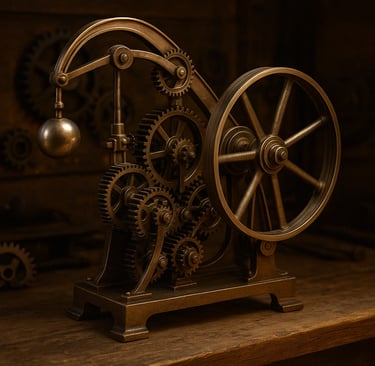
There’s something undeniably romantic about the idea of a machine that powers itself forever. No fuel, no battery, no plug—just motion, endless and effortless. It’s the kind of idea that feels like it should be possible. I remember seeing one in a dusty book as a kid—gears spinning, balls rolling, arms swinging—and thinking, why hasn’t anyone built one of these yet?
Turns out, there’s a very good reason. Actually, several.
The Dream vs. The Laws of Physics
A perpetual motion machine, by definition, is a device that can work indefinitely without an external energy source. And while that sounds amazing, it runs directly into two massive roadblocks: the First and Second Laws of Thermodynamics.
First Law (Conservation of Energy): You can’t get more energy out than you put in.
Second Law (Entropy): Energy systems tend to lose usable energy over time—usually as heat.
No matter how clever the design, friction, air resistance, and material imperfections always show up and slowly sap away energy.
But People Still Try
Despite being “impossible,” people haven’t stopped trying. That’s the part I find most interesting. From medieval overbalanced wheels to 20th-century magnetic engines, every generation has had its tinkerers. And even today, YouTube is full of ambitious creators uploading videos of their latest attempts.
Some of these machines are incredibly well-built. Watching the gears spin and weights fall in a synchronized dance is oddly satisfying—even if it all grinds to a halt after a few minutes.
What I Learned From Building One (Sort Of)
I once tried to replicate a classic overbalanced wheel design with 3D-printed parts and some aluminum rods. The goal? Pure curiosity. It looked amazing, spun for a while… then stopped. As expected. But even in failure, I understood why people keep coming back to this idea—it’s the allure of solving an unsolvable puzzle.
Trying to build one taught me more about energy transfer, friction, balance, and mechanical design than any textbook ever could. The process was messy, fun, and humbling.
The Value Isn’t in the Machine—It’s in the Curiosity
While no one’s ever created a working perpetual motion machine (and likely never will), the pursuit still has value. It sparks creativity. It encourages experimentation. And in many cases, it’s the stepping stone to other real breakthroughs in mechanics and energy systems.
Final Thoughts
Perpetual motion machines may be physically impossible—but they’re a symbol of human imagination at its most stubborn and brilliant. It’s a story about refusing to accept limits, even when science says “no.” And sometimes, chasing the impossible leads us to discover what is possible.
Perpetual Motion Machine
The perpetual motion device infinite looping perpetual motion machine will amaze you.
❤️Our team loves this product:
Engineering Lovers is a participant in the Amazon Services LLC Associates Program, an affiliate advertising program designed to provide a means for sites to earn advertising fees by advertising and linking to engineering-lovers.eu
Disclaimer
The content is for informational and educational purposes only. While we strive for accuracy, we make no guarantees about completeness or reliability. The opinions expressed are those of the authors and do not reflect professional engineering advice. Always consult a qualified expert before making technical or safety-related decisions.
© 2025. All rights reserved.
Privacy Policy
Engineering Lovers is a participant in the Amazon Services LLC Associates Program, an affiliate advertising program designed to provide a means for sites to earn advertising fees by advertising and linking to engineering-lovers.eu